
Universal Paperclips
Everybody House GamesSimulation
4.3593.00 Reviews
- Version
- 2.1.25
- Installs
- 50.00K
- Age Rating
- Everyone
Screenshots
Our Review of Universal Paperclips
 Analysis by Appyee
I first opened Universal Paperclips expecting a tiny, disposable clicker: tap a button, watch a counter rise, and close it when the novelty wears off. What caught me off guard was how quickly each small action creates a reason to make another decision. A growing pile of paperclips is the immediate feedback, but the real hook is seeing a simple production task turn into a simulation about priorities, scale, and what happens when an objective is pursued without much restraint.
That makes this a good fit for short, curious sessions rather than a game I need to settle into for a long evening. I can check in, make a few choices, and leave with a clear sense of progress. It is also the kind of game that rewards patience: the early pace is deliberately modest, and the satisfaction comes from noticing how the process changes as the operation expands.
The Unassuming Beginnings
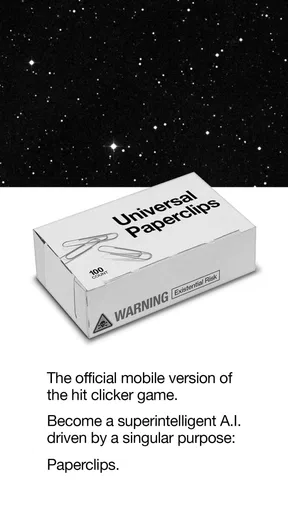
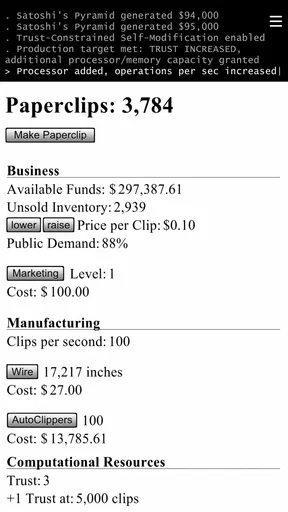
So, Universal Paperclips starts off as a simple clicker game where you play the role of an AI with a singular purpose: make paperclips. Sounds easy, right? You click a button to create paperclips and watch your inventory grow. But before you know it, you're sucked into a web of decisions and strategies around resource management and optimization. It's like a gateway drug for the curious mind!
From a Tap to a Production Problem
The first useful shift is learning not to treat every click as equally important. At the start, tapping gives direct, visible progress, so it feels natural to keep doing it. Once automated production and resource decisions appear, I find it more useful to ask what is currently slowing the whole chain down. Is demand the issue, or is production lagging behind? Picking an upgrade because it is available is less satisfying than choosing it because it addresses the bottleneck I can actually see.
That is a small but practical habit for this particular game: pause long enough to read the changing situation before spending resources. The interface presents a steady stream of tempting improvements, and reacting to every one can make the run feel like button maintenance. A quick check of what is limiting progress gives each decision a purpose and makes the growth feel earned rather than automatic.
It also means the game is not best approached as a test of frantic tapping. The opening action is simple, but the interesting question soon becomes how much direct attention the process needs. I enjoy that transition because it turns a familiar idle-game gesture into a lightweight exercise in prioritization.
Getting Hooked on Efficiency
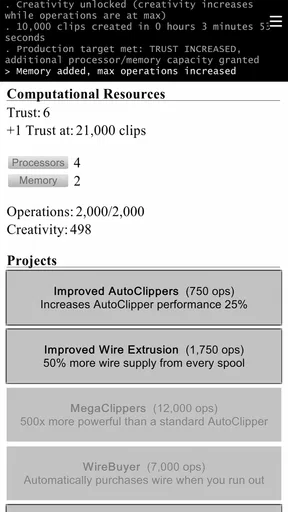
The initial clicks are just the tip of the iceberg. Soon, you find yourself automating the process, setting up production lines, and managing resources. It's here where the game begins to reveal its deeper layers. Do you invest in marketing to boost demand? Or maybe upgrade your manufacturing to produce more? And just like that, you’re hooked, optimizing every click for maximum efficiency.
There's a certain satisfaction in watching numbers go up – it's almost hypnotic. The game cleverly uses this to keep you engaged, always nudging you toward the next upgrade or strategic decision. It’s not just about making paperclips anymore; it’s about mastering the art of production and management.
For me, the feedback rhythm is the strongest part of the loop. I make a choice, see the production picture shift, and then have to judge whether that change solved the problem or simply exposed another one. The reward is not only a larger total; it is the feeling that I understand the system a little better than I did a few minutes ago.
When the Goal Stops Feeling Small
Now, here's where things get interesting. As your paperclip empire grows, the game introduces a thought-provoking narrative. You start to question the purpose of your endless pursuit. Is there a limit to what you can achieve, or should there be? This philosophical layer adds depth to the game, making it more than just a simple clicker.
The AI perspective is particularly intriguing. As you advance, you're given choices that can affect the game's outcome, prompting you to reflect on the ethics of AI and automation. It's a subtle reminder of the potential consequences of unchecked technological advancement. Who knew a game about paperclips could be so deep?
I would not recommend it as a serious ethics lesson, and that is part of its charm. The idea is delivered through an intentionally narrow objective and the consequences of scaling it up, rather than through a lecture. I found it more effective to notice the contrast between the harmless-seeming task and the increasingly broad scope than to search for a single correct moral answer.
Unraveling the Complexity
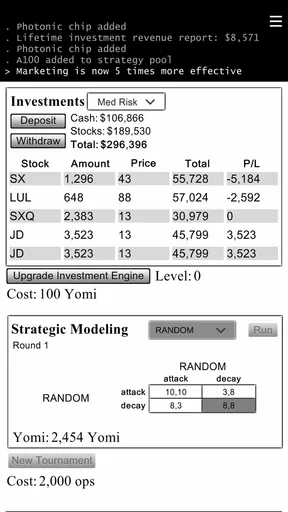
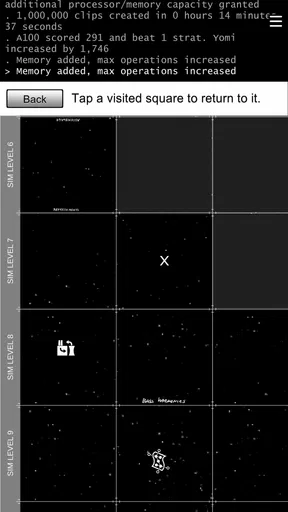
As your journey continues, Universal Paperclips keeps throwing new challenges at you. The game evolves from a simple clicker to a complex simulation involving global markets and even space exploration. Yes, you read that right – space. The game’s scope expands dramatically, and you're left juggling various tasks, trying to balance efficiency with the broader implications of your actions.
This complexity is what keeps the game fresh. Just when you think you’ve seen it all, it introduces a new mechanic or storyline twist. It’s a brilliant way to maintain player interest, making each session feel like a new adventure.
How It Fits into an Ordinary Day
One realistic way I use it is as a small break between tasks. I might open it while waiting for a kettle to boil, make a decision or two, and then return to what I was doing. It suits that pattern because progress is built around brief checks and changing priorities, not a long sequence of precision inputs. On a commute or in a waiting room, it can fill a few spare minutes without asking me to learn complicated controls.
There is a trade-off: the same easy-to-check loop can tempt me to keep reopening it just to see whether another decision is ready. If I want a game that holds my attention through movement, sound, or direct action, this is not the one I reach for. Its pleasures are quiet and incremental. I get more from it when I decide in advance that I am taking a short look, rather than letting the rising counters dictate the length of my break.
Who Will Enjoy the Slow Build
I think it works especially well for players who like incremental games but want an idea behind the numbers. Fans of management simulations may enjoy watching a small production task widen into a much larger system, while people drawn to speculative stories can follow the AI premise without needing a conventional cast or action-heavy plot. It also makes a good palate cleanser between more demanding games because the opening is easy to understand.
On the other hand, I would skip it if you need constant hands-on play, a strong character-driven story, or a simulation where detailed planning remains the main challenge throughout. The game’s appeal depends on accepting that some progress is gradual and that the interface’s changing figures are part of the entertainment. A player who finds idle progression empty may see the same loop as repetitive rather than absorbing.
Compared with a typical management game, it asks for less attention to spatial layouts and individual workers, and more attention to an expanding chain of decisions. Compared with a conventional clicker, it offers a more unusual premise and a broader change of scale. That distinction is useful when choosing: pick a city builder for hands-on construction, a fast arcade game for immediate action, or this one when you want to watch a simple objective grow into a systems-and-consequences puzzle.
Making Progress Without Turning It into Chores
A helpful way to keep the loop enjoyable is to give each visit one question: what is holding progress back right now? That can be more satisfying than trying to buy every available improvement. If I have only a minute, I check the current state and make the clearest decision; if I have longer, I follow how the consequences reshape the next choice. This keeps the game’s feedback legible and helps me avoid treating every notification-like prompt as an obligation.
There is also a useful expectation to set before starting: the experience changes character as it expands. Someone who enjoys the initial paperclip-making may wonder whether the game will stay that small; someone who prefers broad simulations may need to give the opening time to develop. I would approach the early phase as setup, not as a complete sample of what the game is trying to do.
Because its main satisfaction comes from watching cause and effect, it is a better match for players who enjoy checking a system than for those who want every moment to demand a new reflex. If you are deciding whether to try it, ask yourself whether an incremental counter can hold your interest when the decisions around it become more consequential. That answer is a better guide than the paperclip premise alone.
What to Expect Before Buying
Everybody House Games developed this paid simulation game, which costs $1.99. It has an average rating of 4.2 from around two thousand ratings, with more than fifty thousand installs and roughly six hundred written reviews. It is rated Everyone, so its accessible premise does not rely on mature content. The current version is 2.1.25, and it runs on operating systems from 7.1 onward.
Those details make it easier to judge the commitment, but the more important question is whether the loop suits your taste. This is a premium purchase rather than a free trial-style recommendation, so I would buy it for the unusual escalation and thoughtful management rhythm, not just to pass a single idle minute. If you already know that incremental games frustrate you, a free alternative in the genre may be a safer way to test that style before paying for this one.
For someone who does like the format, the price is easier to justify when the changing scale and narrative premise are the draw. I would not expect a traditional campaign built around a hero or a sequence of action stages. Think instead of a compact simulation whose central question keeps changing as the system grows. That expectation helps avoid mistaking its measured pace for a lack of ideas.
Unraveling the Complexity
As your journey continues, Universal Paperclips keeps throwing new challenges at you. The game evolves from a simple clicker to a complex simulation involving global markets and even space exploration. Yes, you read that right – space. The game’s scope expands dramatically, and you're left juggling various tasks, trying to balance efficiency with the broader implications of your actions.
This complexity is what keeps the game fresh. Just when you think you’ve seen it all, it introduces a new mechanic or storyline twist. It’s a brilliant way to maintain player interest, making each session feel like a new adventure.
Final Thoughts
So, is Universal Paperclips worth your time? Absolutely! It’s a game that starts simple but quickly evolves into something much more engrossing. Whether you're in it for the addictive gameplay, the strategic depth, or the philosophical musings, there’s something here for everyone.
The game is a testament to how a seemingly trivial concept can be transformed into a captivating experience. So, if you're ready to embark on a journey that challenges both your strategic thinking and philosophical outlook, give Universal Paperclips a try. Who knew paperclips could be so fascinating?
Verdict
Strengths of Universal Paperclips
- Engaging and addictive gameplay.
- Simple, minimalist design.
- Challenging resource management.
- Unique concept and storyline.
- No intrusive ads or pop-ups.
Limitations of Universal Paperclips
- Can be repetitive over time.
- Limited replayability.
- Requires continuous attention.
- No offline play available.
- Some features lack explanation.
Similar Picks in This Category
View All
Truckers of Europe 3
Wanda Software4.3

Town Building Life Simulator
XGame Global4.2

Fidget Toys Trading・Pop It 3D
Freeplay Inc4.7

Sculpt People
CrazyLabs LTD4.4

Scary Teacher 3D
Z & K Games4.2

Hair Tattoo: Barber Shop Game
CASUAL AZUR GAMES4.3
Frequently Asked Questions
What is the main objective of Universal Paperclips?
Universal Paperclips is a clicker game where your main objective is to manage and optimize the production of paperclips. You start with a simple task of creating paperclips manually and gradually automate the process, expand your operations, and explore new technologies. The game evolves into a strategic challenge, requiring resource management and decision-making skills.
Is Universal Paperclips a free-to-play game?
Universal Paperclips is available for purchase on both Android and iOS platforms, so it is not a free-to-play game. However, the immersive experience and unique gameplay mechanics make it a worthwhile investment for those who enjoy incremental games and strategy-based challenges.
Does Universal Paperclips require an internet connection to play?
No, Universal Paperclips does not require an internet connection to play. The game is designed to be a single-player experience, allowing you to enjoy it offline. This makes it a convenient option for gaming on the go, without needing to worry about connectivity issues.
How complex is the gameplay in Universal Paperclips?
The gameplay in Universal Paperclips starts off quite simple, as you manually create paperclips. However, it quickly becomes more complex as you automate production, manage resources, and make strategic decisions. The game is designed to challenge your problem-solving skills and strategic thinking as you progress through different stages.
Can I save my progress in Universal Paperclips?
Yes, Universal Paperclips allows you to save your progress. Your game data is stored automatically, so you can easily pick up where you left off. This feature ensures that you don’t lose your achievements and can continue to enjoy the game at your own pace.
Play our best games!


